
|
|
 History of Judaism
The Old Testament books of the Bible describe numerous struggles of the Jewish people. After their triumphant Exodus from Egyptian captivity following Moses, they wandered around in the desert for forty years before entering the Promised Land. They had many conflicts with neighboring societies, yet for several centuries were able to maintain a unified state centered in Jerusalem.
This occupation of the Promised Land was not to last, however. In 722 BC, the northern part of the Hebrew state fell to Assyrian raiders. By 586 BC, Jerusalem was conquered by Babylonians. The land of Israel was successively ruled by Persians, Macedonians, Greeks, Syrians, and Romans in the time that followed. As a result of the Syrian King Antiochus IV Epiphanes' attempt to suppress the Jewish religion, a rebellion led by Judas Maccabaeus in 167 BC resulted in the independence of the Jewish nation. This is celebrated today by the festival Hanukkah.
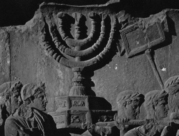
In 70 AD, the Roman army destroyed Jerusalem, and the Jews were forced out of the area and settled in Mediterranean countries and in other areas in southwest Asia. This migration of the Jewish population is known as Diaspora. Many of these Jews settled in Europe and became victims of persecution and poverty. Ghettoes and slums became their homes and massacres were common. Because of these living conditions, many fled to the United States in the late 19th century. Migration to the States especially climbed during the aftermath of the Holocaust, the organized murder of Jews during and after World War II. Today the United States has the largest population of Jewish people with high concentration areas in New York, Los Angeles, Chicago, Boston, Miami, and Washington D.C.
In 1917, an attempt to reestablish Palestine as the Jewish homeland began. By 1948, the State of Israel became an independent country. They have regained their Hebrew language, which involved inventing words for modern inventions and concepts unheard of centuries ago and writing a Hebrew dictionary to unify the language.
History of Judaism
The Old Testament books of the Bible describe numerous struggles of the Jewish people. After their triumphant Exodus from Egyptian captivity following Moses, they wandered around in the desert for forty years before entering the Promised Land. They had many conflicts with neighboring societies, yet for several centuries were able to maintain a unified state centered in Jerusalem.
This occupation of the Promised Land was not to last, however. In 722 BC, the northern part of the Hebrew state fell to Assyrian raiders. By 586 BC, Jerusalem was conquered by Babylonians. The land of Israel was successively ruled by Persians, Macedonians, Greeks, Syrians, and Romans in the time that followed. As a result of the Syrian King Antiochus IV Epiphanes' attempt to suppress the Jewish religion, a rebellion led by Judas Maccabaeus in 167 BC resulted in the independence of the Jewish nation. This is celebrated today by the festival Hanukkah.
In 70 AD, the Roman army destroyed Jerusalem, and the Jews were forced out of the area and settled in Mediterranean countries and in other areas in southwest Asia. This migration of the Jewish population is known as Diaspora. Many of these Jews settled in Europe and became victims of persecution and poverty. Ghettoes and slums became their homes and massacres were common. Because of these living conditions, many fled to the United States in the late 19th century. Migration to the States especially climbed during the aftermath of the Holocaust, the organized murder of Jews during and after World War II. Today the United States has the largest population of Jewish people with high concentration areas in New York, Los Angeles, Chicago, Boston, Miami, and Washington D.C.
In 1917, an attempt to reestablish Palestine as the Jewish homeland began. By 1948, the State of Israel became an independent country. They have regained their Hebrew language, which involved inventing words for modern inventions and concepts unheard of centuries ago and writing a Hebrew dictionary to unify the language.
 Basic Beliefs of Judaism
Judaism is a monotheistic religion which believes that the world was created by a single, all-knowing divinity, and that all things within that world were designed to have meaning and purpose as part of a divine order. According to the teachings of Judaism, God's will for human behavior was revealed to Moses and the Israelites at Mount Saini. The Torah, or commandments, which regulate how humans are to live their lives, were a gift from God so that they might live in according to His will.
Statement of Faith
Moses Maimonides, a Spanish Jew who lived in the 12th century, tried to condense the basic beliefs of Judaism into the form of a creed. It is still followed by the traditional forms of Judaism.
Basic Beliefs of Judaism
Judaism is a monotheistic religion which believes that the world was created by a single, all-knowing divinity, and that all things within that world were designed to have meaning and purpose as part of a divine order. According to the teachings of Judaism, God's will for human behavior was revealed to Moses and the Israelites at Mount Saini. The Torah, or commandments, which regulate how humans are to live their lives, were a gift from God so that they might live in according to His will.
Statement of Faith
Moses Maimonides, a Spanish Jew who lived in the 12th century, tried to condense the basic beliefs of Judaism into the form of a creed. It is still followed by the traditional forms of Judaism.